

You’re finally ready to move up from your rental unit to your own home. Before you start searching for a home, understand how much money you’ll really need. Be prepared for the myriad expenses that you must add to the purchase price to see the whole picture.
Home ownership has several advantages over renting, including lower monthly payments, deductible mortgage interest, and the accumulation of equity. But there is a definite price to pay for these benefits.
The biggest spend is your initial equity. There are two costs that constitute the beginning equity in your home. The first is earnest money, typically $500 to $2,0001 , that ensures your commitment to the deal. You can get a refund if the deal falls through due to no fault of your own. The other initial spend is your down payment, which typically ranges from 3.5 to 20%. You make the down payment at the closing. Your mortgage covers the difference between the purchase price and the initial equity.
Fees, fees, fees. It seems every time you turn around, you'll encounter another fee. Sellers typically pay the broker's fee, but if you use a buying agent, expect to pay up to 3%2 of the purchase price. Frequently, mortgage lenders charge an origination fee up to about 1% for the privilege of lending you money. You'll encounter various other fees, such as those for inspections and surveys. Often, you'll be asked to pay points, which is prepaid interest on the mortgage loan.3 Other fees may be charged by a homeowner's association, a title company, the recorder of deeds, and others.
Don’t forget the insurance and taxes. You won’t be able to get a mortgage without first getting homeowner’s insurance, with an average annual premium of approximately $1,200. You may also need flood insurance, based upon your location. Many lenders require you buy private mortgage insurance at an annual cost of 0.5 to 1.0% if your down payment is below 20%. You may also want to buy title insurance to ensure you have clear title to the property. Many folks purchase title-lock insurance to cover losses from mortgage fraud due to identity theft.
Figure move-in costs and initial repairs. Unless you do it yourself, it may cost you several thousand dollars to engage a moving service – the cost depends on the distance to the new property and how much stuff is being moved. In addition, you may face immediate repair expenses for problems that the seller has not agreed to fix before closing. Expensive repairs can include a new roof, new HVAC, structural changes, expansions, landscaping, etc. You may also have to pay a fee for a building permit. The worst-case scenario involves necessary, unexpected repairs not identified in the engineer’s inspection report.
Buying your first home is an enormous step. That’s why it’s essential to have your finances in order first. A well-rounded financial plan will show you how much home you can afford without shortchanging your retirement and other life events. Contact CEFCU Investment Services today at 1.800.356.7865 ext. 32571 to review your financial plan and ensure you are on solid ground before making an expensive commitment. Together, we can find the financial comfort zone for your home purchase.
LPL Financial Professionals do not offer mortgage or lending services. Contact a mortgage or lending professional regarding these services.
This material is for general information only and is not intended to provide specific advice or recommendations for any individual. There is no assurance that the views or strategies discussed are suitable for all investors or will yield positive outcomes. Investing involves risks including possible loss of principal.
This material was prepared by LPL Financial, LLC.
1 https://www.hud.gov/topics/common_questions
2 https://www.thebalance.com/how-do-buyer-s-agents-get-paid-1798872 [3/26/22]
3 https://www.bankrate.com/mortgages/closing-costs-vs-prepaids/ [6/27/22]
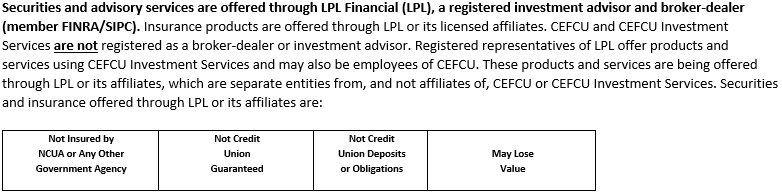
Securities and advisory services are offered through LPL Financial (LPL), a registered investment advisor and broker-dealer (member FINRA/SIPC). Insurance products are offered through LPL or its licensed affiliates. CEFCU and CEFCU Investment Services are not registered as a broker-dealer or investment advisor. Registered representatives of LPL offer products and services using CEFCU Investment Services, and may also be employees of CEFCU. These products and services are being offered through LPL or its affiliates, which are separate entities from, and not affiliates of, CEFCU or CEFCU Investment Services. Securities and insurance offered through LPL or its affiliates are:
- Not Insured by NCUA or Any
other Government Agency - Not Credit Union
Guaranteed - Not Credit Union
Deposits or Obligations - May Lose
Value
Your Credit Union (“Financial Institution”) provides referrals to financial professionals of LPL Financial LLC (“LPL”) pursuant to an agreement that allows LPL to pay the Financial Institution for these referrals. This creates an incentive for the Financial Institution to make these referrals, resulting in a conflict of interest. The Financial Institution is not a current client of LPL for advisory services. Please visit https://www.lpl.com/disclosures/is-lpl-relationship-disclosure.html for more detailed information.
The LPL Financial registered representative(s) associated with this website may discuss and/or transact business only with residents of the states in which they are properly registered or licensed. No offers may be made or accepted from any resident of any other state.


